Every owner I've pitched on video has the same first reaction. A pause, a slow look down at the work shirt, then: "Do I have to be in it?" (Yes. Sorry.) The second reaction is a question about drones.
Homeowners don't hire the drone. They hire the person who knocks on the door, and video lets them meet that person on the couch a week early.
On this page:
- Which videos book jobs
- What video marketing for contractors means
- Owner-on-camera ads
- Project walkthroughs
- Client testimonial videos
- YouTube vs Reels and Shorts
- Recording on a phone
- Hooks, length and ad fatigue
- Video marketing mistakes
- What we see in the field
- Common questions
Which Contractor Videos Actually Book Jobs?
Three kinds of video book jobs for high-ticket contractors: the owner on camera talking about a problem homeowners already have, a walkthrough of a real project, and a past client explaining what it was like to hire you. Everything else is decoration. Here's how they stack up on the accounts we run.
| Video | What it does | Where it runs | Length that works |
|---|---|---|---|
| Owner-on-camera ad | Earns trust and gets the appointment | Facebook and Instagram feeds and Reels | 30 to 90 seconds |
| Project walkthrough | Shows the work at backyard scale | Ads, YouTube, your landing page | 1 to 3 minutes, longer on YouTube |
| Client testimonial | Proves a neighbor hired you and was glad | Retargeting ads, landing page, YouTube | 1 to 2 minutes cut down, full version on YouTube |
| Short organic clip | Keeps your face familiar between ads | Reels, Shorts | Under 30 seconds |
| Logo intro or drone flyover | Looks expensive | Usually skipped | About three seconds of patience |
That last row hurts some feelings. If you've paid for a drone flyover, I'm sorry to report the homeowner watched it the way you watch the safety demo on a plane: politely, and not at all.
What Is Video Marketing for Contractors?
Video marketing for contractors is using video to get a homeowner to trust you before you've met. In practice that's ads with the owner on camera, walkthroughs of real jobs and testimonials from past clients. Good contractor video marketing isn't chasing views. It's chasing booked appointments with homeowners who already like you when you knock.
The wider data says video pulls its weight. Wyzowl has surveyed marketers and consumers about video for 12 years running, and its 2026 video marketing report (266 respondents, surveyed in late 2025) found:
| Finding | 2026 |
|---|---|
| Businesses using video as a marketing tool | 91% |
| Video marketers who say video generated leads | 85% |
| Video marketers who say video directly increased sales | 83% |
| People who've been convinced to buy by watching a video | 85% |
| Marketers who say videos of 30 seconds to 2 minutes work best | 71% |
Source: Wyzowl, Video Marketing Statistics 2026. All industries, not contractors only.
Those are all-industry numbers, so read them as a trend, not a forecast for your county. The useful one is the 85%: most buyers have already been talked into something by a video. Your job is to make sure the video was yours.
Owner-on-Camera Ads: The Contractor Video Ads That Work Best
Owner-on-camera ads are the contractor video ads that book the most appointments for us. The owner talks straight into a phone about a worry the homeowner already has, then offers one clear next step. They work because the homeowner meets you before the estimate, so the visit starts warm instead of cold.
Derek L., outdoor living contractor outside Nashville, 30 days in: 37 appointments and $46,000 signed on $1,295 of ad spend.
Derek L. is 21. Before his ads ran, homeowners would meet him on the driveway and do math about his age instead of his work, so he showed up to every estimate with a speech ready to defend himself. Imagine prepping a closing argument just to measure a backyard.
We put his face in the ads instead. His first two appointments came in within 6 hours of launch, and his words on the change were simple: "They're not scared when they see me young, because they saw me already on the ad." The full story is in how a 21-year-old deck builder stopped losing jobs to his age.
A good owner ad has four parts, and none of them is your logo:
| Part | When | What the owner says |
|---|---|---|
| Hook | First 3 seconds | The homeowner's worry, in their words |
| Proof | Next 15 to 30 seconds | One thing you do that the cheap guy skips |
| Offer | Middle | What they get by booking, such as a free design and estimate |
| Next step | Last 5 seconds | Exactly what to tap and what happens after |
Your name and your years in business can live somewhere in the proof. The homeowner didn't open the app to hear your résumé, and they'll leave before you reach year 22.
Project Walkthrough Videos: Show the Work at Eye Level
A project walkthrough is a one-to-three-minute video of a finished or in-progress job, recorded at the height a person stands, with the owner pointing out the choices that matter. It turns "nice deck" into "these people know what they're doing." Walkthroughs run well as ads and live even better on YouTube.
This is where the drone people get defensive. A drone shows a deck the way a seagull sees it, and seagulls don't sign contracts. Homeowners picture the project from their back door, so record it from a back door.
| Stop on the walkthrough | What to point at | Why homeowners care |
|---|---|---|
| The back door | The first view a guest gets | That's how they'll picture their own yard |
| Underneath | Footings, framing, flashing | Shows what a cheaper bid leaves out |
| The railing | Height, spacing, how it's fastened | Safety, kids and the in-laws |
| The detail they didn't ask for | Drainage, lighting, a hidden fastener | Proof you think about the job after it's paid for |
| The best seat | Where the family will actually sit | End on the feeling, not the logo |
One decision per stop is plenty. Explaining every board is how a three-minute walkthrough becomes a 40-minute lecture on joist spacing (riveting for you, a hostage situation for everyone else).
Client Testimonial Videos: Let the Homeowner Say It
Client testimonial videos are short interviews where a past customer explains why they hired you and how it went. They're the strongest proof you can show a homeowner who's comparing bids, because the claim comes from a neighbor, not the person cashing the check. Use them in retargeting ads and on the page people land on.
We do this ourselves. There are about 17 client testimonial videos on our site, and here's one of my favorites, because it's a contractor explaining what happened once he got in his own ads.
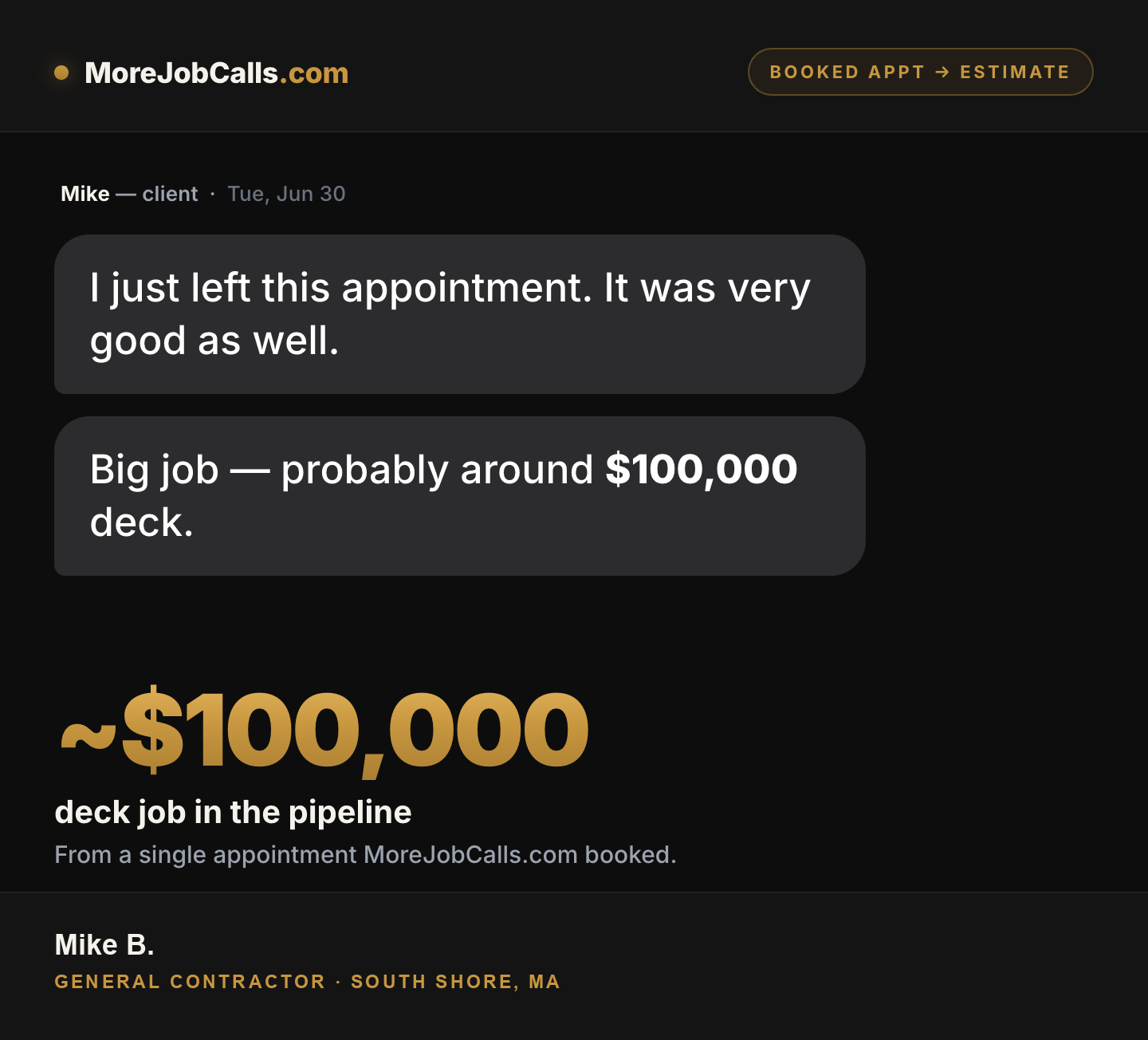
Mike B., general contractor building decks and modular homes on the South Shore of Massachusetts.
Mike B. had never been on camera. Now most of his ads are him talking, and homeowners open the door with "It's the guy from the ad." He went from 3 appointments a week to between 3 and 11 a day, and was booked out close to 6 months. Mike's full interview is broken down here.
Getting a testimonial from your own customers is easier than it sounds. Ask on the final walkthrough day, when they're happiest and the deck still smells like fresh lumber. Prop the phone on a tripod and ask three questions: what worried you before you hired us, what surprised you, and what would you tell a neighbor.
Don't script the homeowner. Scripted homeowners sound like they're reading a statement in front of a bank of microphones, and every viewer can tell.
YouTube vs Reels and Shorts: Where Contractor Video Should Run
Run paid video first on Facebook and Instagram, because that's where you can put a vertical ad in front of homeowners in your service area before they search. Use YouTube for the long versions people check before they book: full walkthroughs and full testimonials. Treat organic Reels and Shorts as a bonus, not the plan.
| Where | Best video | Length | Its job |
|---|---|---|---|
| Facebook and Instagram ads | Owner-on-camera ads, cut-down testimonials | 30 to 90 seconds, vertical | Book appointments |
| YouTube | Full walkthroughs, full testimonials, explainers | 3 to 20 minutes | Get researched and trusted |
| Reels and Shorts, unpaid | One face, one claim | Under 30 seconds | Free reach and familiarity |
| Your landing page | Owner intro and a testimonial | 1 to 3 minutes | Settle nerves before the form |
Short video isn't a niche anymore. YouTube's CEO says Shorts now averages 200 billion daily views, which is roughly 200 billion more than the company Facebook page got last year. The catch is that unpaid reach is a lottery. In my experience the organic clips that travel open on a face and a claim in the first few words, finish under 30 seconds, and don't end with a sales pitch.
Paid video ads for contractors are where the appointments come from. If you're still deciding where the ad budget goes, read Google Ads vs Meta ads for contractors first. For a deck company, Facebook ads for deck builders divides out a real account from inquiry to signed job.
How to Record Contractor Videos on Your Phone
Record contractor videos on the phone you already own: vertical, at eye level, facing a window or outside in shade, with a clip-on mic. At MoreJobCalls we write the script, the owner records it on their phone, and we edit and test it. The owner's whole job is one sitting of talking to a camera.
Our homepage puts it plainly: "One two-hour shoot every 2 to 4 weeks becomes 90 pieces of ad creative." Here's all the gear that takes.
| Gear | What it does | Need it? |
|---|---|---|
| Your phone | Camera, and it's already in your pocket | Yes |
| Clip-on mic | Clean audio over wind and saws | Yes |
| Tripod or phone clamp | Steady shot at eye level | Yes |
| Ring light | Even light indoors | Nice to have |
| Gimbal | Smooth walking shots | Not yet |
| Drone | The seagull's view | Put it down |
The recording itself goes like this:
- Get the script first. Hooks, middles and closes as separate short lines, so one sitting produces many ads.
- Phone vertical, lens at eye level. Below the chin is the look of a man reading a text he didn't want.
- Face the light. A window in front of you, never behind you, unless you're going for witness protection.
- Record every hook, then every middle, then every close, in one take. Say the label out loud first, "hook three," so the editor can find it.
- Flub a line? Pause and say it again. Don't stop the recording. The editor cuts the pause.
- Send the raw file. Don't add music, captions or a logo. That's our job, and it's a job that needs testing.
Most owners do the same thing on the first take: ask "is it recording?" and then stare at the lens like it owes them money. By the third hook they're talking like they do at a kitchen table, which is the whole point. If you'd rather hand the script, edit and testing to someone, that's built into our contractor marketing agency work.
Hooks, Length and Ad Fatigue
A contractor video ad has about three seconds to earn the next thirty. Open on the homeowner's worry or a specific claim, never your name or a logo. Keep ads between 30 seconds and 2 minutes, and expect even a winning ad to wear out, so plan new hooks every few weeks.
| Hook type | Sounds like | Why it stops the scroll |
|---|---|---|
| The worry | "If you've put off your deck because you're scared of hiring the wrong guy, watch this." | Says the thought they haven't said out loud |
| The inspection | "Here's the first thing I check on every old deck." | Makes them want to go look at theirs |
| The objection | "Why our estimates take an hour instead of ten minutes." | Turns a weakness into a reason to trust you |
| The callout | "If your house was built before 1990, look at your railing." | The right homeowner feels picked out of the crowd |
On length, the 71% of marketers in the Wyzowl report who picked 30 seconds to 2 minutes match what we see. A homeowner will give you a minute on purpose. They won't give you five by accident.
Ad fatigue is what happens when the same people see the same ad too many times. It shows up as cost per appointment creeping up for a couple of weeks while nothing else changed. An ad wears out like a radio jingle: catchy the first time, and by the fortieth you'd pay money to never hear it again.
The cheapest fix is a new hook on the same body, which is exactly why one recording sitting should produce a stack of hooks. Then test a new middle, then a new offer.
Contractor Video Marketing Mistakes That Waste the Budget
The three contractor video marketing mistakes I see most are selling instead of teaching, opening with who you are instead of the homeowner's problem, and polishing the video until it looks like an ad. None of them is a budget problem. I broke each one down, with the fix, in the three contractor video marketing mistakes that kill ads.
The short version: the more a video looks like a commercial, the faster a thumb moves past it. Homeowners have been trained since childhood to leave the room when the jingle starts.
What We See in the Field
Here's what shows up across the contractors we run video ads for. First name and last initial only, because we never publish a client's business name.
- The owner's face beats the logo. Both contractors below were in their own ads, and both say homeowners showed up already sold on them.
- Recognition happens at the door. "It's the guy from the ad" is the sound of a cold appointment turning warm.
- The calendar can outrun the crew. Mike B. hit 11 estimates in a day. Plan for capacity before the video works, not after.
- Phones are enough. We don't send a crew. We script it, the owner records it on a phone, and we edit and test it.
| Contractor | Video in the ads | What it produced |
|---|---|---|
| Derek L., outdoor living, TN | Owner on camera, age and all | 37 appointments and $46,000 signed in 30 days on $1,295 |
| Mike B., decks and modular, MA | Owner talking in most of the ads | From 3 appointments a week to 3 to 11 a day, booked out close to 6 months |
Common Questions
What kind of videos should a contractor make?
Start with owner-on-camera ads: the owner talking into a phone about a worry the homeowner already has, with one clear next step. Add project walkthroughs of real jobs and short testimonials from past clients.
How long should a contractor video ad be?
Most contractor video ads work best between 30 seconds and 2 minutes, and 71% of marketers in Wyzowl's 2026 survey picked that same range. The first three seconds matter most.
Do contractors need a professional videographer?
No. A phone, a clip-on mic and a tripod are enough, and phone video usually performs better in a social feed because it looks like a person, not a commercial. What matters is the script and the hook. The camera barely matters.
Is YouTube or Facebook better for contractor videos?
They do different jobs. Facebook and Instagram ads put short vertical video in front of homeowners in your area before they start searching, which is what books appointments. YouTube holds the longer walkthroughs and testimonials people check before they book.
How often should contractors make new video ads?
Plan for fresh creative every few weeks. Even a winning ad wears out as the same homeowners see it again and again. Recording many hooks in one sitting gives you new versions to test without a new shoot.
How much does video marketing cost for a contractor?
The equipment is a phone, a clip-on mic and a tripod. The real costs are ad spend and the time to script, edit and test the videos. If you want that part handled, you get the real number on a 30-minute strategy call.
Where to Start
Start with one owner-on-camera ad and one testimonial from your happiest customer this year. If you want the script written, the edit done and the testing run inside your own ad accounts, that's what our contractor marketing system does. You record. We handle everything after the phone.
And the drone? Keep it. It's great for checking gutters.