Somewhere right now, a contractor is sitting across from a branding agency, nodding at a mood board. There's a gray swatch named "Slate Confidence." There's a new logo with the hammer tilted 12 degrees, which I'm told signals innovation.
I get the appeal. A rebrand is the one marketing purchase you can show your spouse at dinner. Nobody frames a cost-per-appointment report (I tried once, and it didn't go with anything).
Homeowners don't hire the font. They hire the person they trust with the backyard. So this list ranks contractor branding ideas by booked appointments. What to build before any of this is in contractor branding vs lead generation.
On this page:
- The seven ideas, ranked
- The owner's face on the ads
- Truck wraps with a reason to call
- Yard signs with a QR code
- Review volume
- Before-and-after posts
- The same name, address and phone
- A website that answers price and timeline
- Branding spend that's vanity
- Common questions
Contractor Branding Ideas, Ranked by Booked Appointments
Here are seven branding ideas for contractors, ranked by how directly each one turns into a booked appointment. "Direct" means a homeowner sees it and can act today. "Indirect" means it makes every other channel convert better.
| # | Branding idea | How it books appointments | Effect |
|---|---|---|---|
| 1 | Owner's face on the ads | Homeowners meet you before the visit, so they book you instead of shopping around | Direct |
| 2 | Truck wrap with a reason to call | One offer and one big phone number turn traffic into calls | Direct |
| 3 | Yard signs with a QR code | Neighbors scan, see the finished job, book a visit | Direct |
| 4 | Review volume | Fresh reviews keep you on the homeowner's shortlist | Indirect |
| 5 | Before-and-after posts | Shows the result the homeowner is already picturing | Indirect |
| 6 | Same name, address and phone everywhere | Stops lost calls and lost trust | Indirect |
| 7 | Website that answers price and timeline | Homeowners qualify themselves before they call | Indirect |
| - | New logo, brand book, awareness campaign | It doesn't, on its own | Vanity |
Notice where the logo landed. A logo helps people remember you once they know you. It has never introduced you to anybody.
1. Put the Owner's Face on Your Ads
The strongest contractor branding idea is the owner on camera, in the ads, talking about the work. Homeowners are deciding who to let onto their property. When they've already watched you explain a job, the first visit feels like the second meeting, and you stop being one of four quotes.
Derek L. runs an outdoor living company outside Nashville, and he's 21. Homeowners used to meet him on the driveway and spend the estimate quietly doing math on his age. We put his face in the ads, and in his first 30 days he booked 37 appointments and signed $46,000 in jobs on $1,295 of ad spend.
Jason B., a deck builder in Kennewick, Washington, started hearing a new line at the door: "We recognize you from the Facebook stuff." His summary of what changed: "Seems like we're the first ones now versus the third or fourth." He went from 1 to 3 bids a week to 2 or 3 a day inside his first month.
Jason B., a deck builder in Kennewick, Washington, on his first month with his own face in the ads.
You don't need a studio, a teleprompter or a ring light the size of a satellite dish. Here's how we do it: we write the script, you record it on your phone, and we edit it and test it. The slightly sunburned version of you on a job site beats the polished stock-photo version, because homeowners can tell which one is actually going to show up.
2. Truck Wraps With a Reason to Call
A truck wrap is cheap visibility, but visibility isn't a phone call. A wrap earns its money when it gives a stranger at a red light one reason to call and one easy way to do it: a big phone number, a short web address and a single offer, like a free design visit.
The cost side is real. A 2008 3M study, reported by Work Truck Online, found fleet graphics had the lowest average cost per thousand impressions in the comparison, at 48 cents. Television was the highest, at $23. The study is old enough to remember flip phones, and the point still stands: a wrap is about the cheapest way to be seen there is.
Here's the catch. An impression is a guy in a minivan glancing at your tailgate while he decides between Taco Bell and Arby's. He saw you. He isn't calling, because your wrap is a logo, a slogan about craftsmanship and a phone number in a font built for ants.
| A wrap that's just branding | A wrap that books appointments |
|---|---|
| Logo fills the whole side panel | Phone number you can read from 50 feet |
| Slogan: "Quality you can trust" | Offer: "Free deck design visit" |
| Nine services in a list | The one service you want more of |
| A row of social media icons | A short web address you can track |
Give the wrap its own phone number or web address. Then you'll know whether the truck is working or just looking handsome in the Home Depot parking lot.
3. Yard Signs With a QR Code
A yard sign is the only ad that stands right next to its proof: the finished job. Add a QR code that opens a page with photos of that exact project and a booking button, and the curious neighbor gets an easy next step that doesn't involve knocking on a stranger's door.
Every street has one person who walks the dog past your job site three times a day, very slowly, pretending not to look. That's your next customer. Right now your sign hands them a logo and a phone number they'll forget by the mailbox.
Point the code at a page built for that street: before-and-after photos, the project type, how long it took and a button to book a visit. Tag the link so every scan shows up in your numbers. A sign with no code is decoration you paid to stake in someone else's grass.
4. Review Volume: The Contractor Branding Homeowners Actually Check
Reviews are the part of contractor branding homeowners actually read before they call. BrightLocal's 2026 Local Consumer Review Survey found 47% of consumers won't use a business with fewer than 20 reviews, and 74% only care about reviews written in the last three months. Volume and recency beat a perfect logo.
Read that second number again. A wall of five-star reviews from 2021 is a museum exhibit. It tells a homeowner you used to be good.
The fix is a habit, not a campaign. Ask on the last day of the job, while the homeowner is standing on the new deck admiring it and slightly in love with you. In the same survey, 83% of people who were asked for a review left one. The full setup, Google Business Profile included, is in local SEO for contractors.
5. Before-and-After Posts
Before-and-after posts are contractor branding that shows the result instead of describing it. A homeowner with a rotting deck can't picture "quality craftsmanship." They can picture their own sad backyard turning into the one in your photo, and that picture is what gets them to book.
Shoot the before photo from the same spot you'll shoot the after. It sounds obvious. It's also the step everyone forgets, which is how you end up comparing a close-up of one rotten board to a wide shot at golden hour, and the post looks like a magic trick.
| Before-and-after post that's decoration | Before-and-after post that books |
|---|---|
| Different angles, different light | Same spot, same angle, same time of day |
| Caption: "Another happy customer!" | Caption: the project, the material, the timeline |
| Posted once, to followers | Posted, then run as an ad to homeowners nearby |
Write the caption like a job ticket, not a poem: the project, the material, how long it took and what moved the price. "Composite deck, 16 by 20, eleven working days, permit included" does more work than three paragraphs about passion. Then put the same post in your ads, because the people who most need to see it don't follow you yet.
6. The Same Name, Address and Phone Number Everywhere
Consistent business details are the cheapest branding a contractor can fix. In BrightLocal's 2021 Business Listings Trust Report, 63% of consumers said incorrect information on a listing would stop them choosing a business, and 77% had seen conflicting details about a business across different directories.
| Where your details drift | What to check |
|---|---|
| Google Business Profile | Name matches your truck and invoices, current phone number |
| Facebook page | Same phone, same service area |
| Old directory listings | Old numbers, old addresses, old names from before a rebrand |
| Website footer | Same phone as everywhere else |
This one is dull, I'll admit it. Nobody gets excited at a trade show about matching their suite number across 40 directories. But a homeowner who calls a dead number from an old listing doesn't leave a voicemail. They call the next contractor.
A rebrand is the fastest way to break this: new name, new number, and 30 old listings still pointing at the old ones. I've renamed my own company twice, so I say that as a man who has updated a lot of directory listings at midnight. If you rename, fix every listing the same week.
7. A Website That Answers Price and Timeline Questions
The branding job of a contractor website is answering the two questions every homeowner has before calling: roughly what does this cost, and how long will it take. Answer them and you get calls from people who already fit the budget. The ones who don't fit skip the call instead of spending your evening.
That gap is the opportunity. Most contractors worry that a price range scares people off. It does scare some people off, which is the point: the homeowner with a $15,000 budget for a $60,000 project was never going to sign, and now they don't burn your Thursday night finding that out.
You don't have to post a quote. Post a range and what moves it: size, materials, site access and permits. Then add a realistic timeline from first visit to finished job. The real number still gets presented at the appointment, in person, where you can explain every line of it.
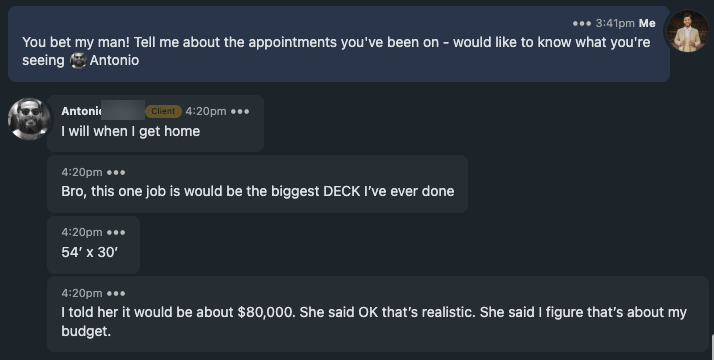
That's what a prepared homeowner sounds like. No sticker shock, no "let me think about it," just a budget that already fits the job.
Contractor Branding Spend That's Vanity
Contractor branding spend is vanity when nobody can show you a booked appointment it produced. A new logo, a brand guidelines PDF, a slogan, swag and awareness campaigns reported in impressions all land here. None of them are evil. They just don't make the phone ring, so they belong after the seven ideas above.
| Vanity spend | What the pitch says | Ask this instead |
|---|---|---|
| New logo | "Elevates the brand" | Which appointments will it add? |
| Brand guidelines PDF | "Keeps you consistent" | Who reads it besides the agency? |
| Awareness campaign | "80,000 impressions this month" | How many booked visits came from it? |
| New slogan | "Positions you in the market" | Would a homeowner ever repeat it? |
| Branded swag | "Keeps you top of mind" | Fine, keep the koozies. Just don't call them marketing. |
If you're being pitched a rebrand right now, ask one question: "How will we know this worked?" If the answer leans on the word "awareness," you have your answer. Whatever you buy, track it to booked appointments and closed jobs, the numbers covered in contractor marketing metrics.
None of this means your logo should look like it was made in Microsoft Paint in 2003. Look professional. Just stop at professional, and put the rest of the money into the ideas that book.
What We See in the Field
Across the contractors we run marketing for, the brand that books is the owner's face, not the logo. Homeowners who've watched the owner on video book faster and show up warmer. They ask fewer price questions, because the ads and the website already answered them.
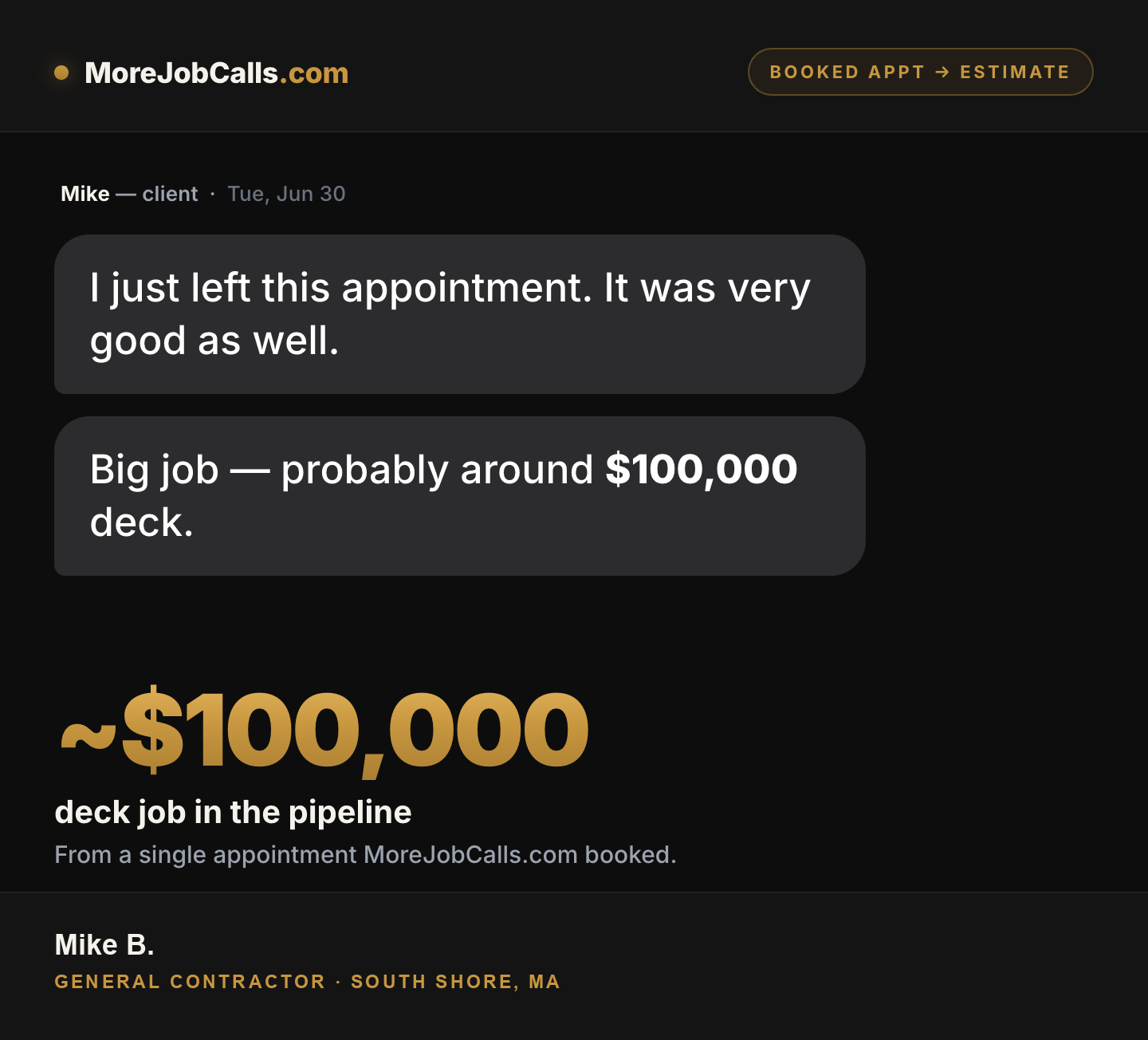
Mike B., a general contractor on the South Shore of Massachusetts, went from 3 appointments a week to between 3 and 11 a day, and was booked close to 6 months out. Chris W., a custom deck and home builder in Gulf Shores, Alabama, booked $320,000 in jobs in about two months on about $100 a day, then paused the ads to hire.
None of them got there with a new logo. They got there with their own faces in front of the right homeowners, and a system that turned that trust into time on the calendar.
Contractor Branding: Common Questions
What are good contractor branding ideas?
The good ones make homeowners call: the owner on camera in your ads, a truck wrap with one offer and a big phone number, yard signs with a QR code, a steady flow of fresh reviews, before-and-after posts, the same business details everywhere, and a website that answers price and timeline questions.
Is a rebrand worth it for a contractor?
Only after the things that book appointments are working. A rebrand rarely adds calls on its own, and a new name or phone number can break your old listings. If you do rebrand, judge it by booked appointments, not impressions.
Are truck wraps worth it for contractors?
A wrap is one of the cheapest ways to be seen. A 2008 3M study put fleet graphics at 48 cents per thousand impressions. Being seen isn't a phone call, though, so give the wrap one offer, a big phone number and a web address you can track.
How many reviews does a contractor need?
At least 20, and recent ones. BrightLocal's 2026 Local Consumer Review Survey found 47% of consumers won't use a business with fewer than 20 reviews, and 74% only care about reviews written in the last three months.
What should general contractor branding include?
A clear name, a clean professional look, the same contact details everywhere, the owner's face, real project photos and steady reviews. Judge anything past that by whether it books appointments.
Where to Start
Start at the top of the list: your face, on your ads, in front of homeowners who haven't picked a contractor yet. That's the core of what our contractor marketing agency builds, inside ad accounts you own, with data you own. What it costs in your market is a real number on a 30-minute strategy call.
| Order | Do this first |
|---|---|
| This week | Fix your name, address and phone on every listing, then ask your last 10 customers for a review |
| This month | Record your first owner-on-camera ad, and add a QR code to your yard signs |
| Next wrap or reprint | One offer, one big phone number, one web address you can track |
And "Slate Confidence"? It's a perfectly nice gray. It'll look great on the office walls once the calendar's full.