Search "deck builder near me" in most towns and you'll find at least one listing called something like "Bob's Decks Best Deck Builder Near Me Cheap Affordable." Bob is trying very hard. Bob is also breaking Google's rules, and we'll come back to Bob.
Local SEO has a reputation for being mysterious, mostly because the people selling it like it that way. Google publishes how the map works. The hard part is doing the boring parts every week for a year.
On this page:
- What local SEO for contractors covers
- How Google ranks contractors in the map
- Step 1: your Google Business Profile
- Step 2: reviews
- Step 3: a website that ranks outside the map
- Local SEO in a small market
- Local SEO and AI search
- How long it takes and what to measure
- What we see in the field
- Common questions
What Is Local SEO for Contractors?
Local SEO for contractors gets you shown to homeowners searching in your service area. It covers three places on the screen, each won differently.
| Where you show up | What decides it | What you control |
|---|---|---|
| The map results | The Business Profile, reviews and distance from the searcher | Categories, services, photos, reviews, replies |
| The regular results under the map | Your website's pages and the sites linking to them | Service pages, real job content, local links |
| AI answers | What your reviews, website and other sites say about you | The same proof, said clearly and consistently |
The map is the big one. In a 2026 WebFX test of 500 home-services searches, the local map pack showed up on 97.6% of them. If you're not in the map, you're not in most of the searches that matter.
How Google Ranks Contractors in the Map
Google tells you how it ranks the map, which is more than most agencies will. In Google's own help page: "Local results are mainly based on relevance, distance, and popularity." The same page says "More reviews and positive ratings can help your business's local ranking."
| Google's factor | What it means for a contractor | Can you change it? |
|---|---|---|
| Relevance | Does your profile match what was searched: the right category and the services listed | Yes, this week |
| Distance | How far your business is from the person searching | Not without moving |
| Popularity | How well known you are: reviews, ratings, links and mentions | Yes, slowly |
Distance is the one nobody wants to hear about. You can't out-optimize the fact that a homeowner on the far side of the metro lives 40 minutes from your shop and 6 minutes from someone else's. Every owner has checked the map from their own driveway, seen themselves in first place and felt great. Drive twenty minutes across town and you've vanished, like a radio station in a tunnel.
So the job is to win the map where you're close, and win the regular results everywhere else. That second part is what your website is for.
Step 1: Set Up Your Google Business Profile Properly
Your Google Business Profile is the single biggest lever in local SEO for contractors, and most of it takes an afternoon. Fill every field, pick the right categories and keep it true. Here's the order I'd work through it in.
| Field | What to do |
|---|---|
| Business name | Your real name. Google's guidelines say it "should reflect your business's real-world name." Sorry, Bob. |
| Primary category | The one that matches the job you most want, not the one that sounds biggest. |
| Service area | Set it honestly. Google says service-area businesses "can't list a 'virtual' office" unless it's staffed during business hours. |
| Services | Every service you sell, in the homeowner's words: composite decks, fence installation, roof replacement. |
| Photos | Real jobs every month: your crew, your trucks, your finished work. Stock photos fool exactly nobody. |
| Phone number | One that gets answered. A profile that ranks first and goes to voicemail is a very well-optimized way to lose a job. |
That last one matters more than any ranking factor. Every call your profile produces is a homeowner who picked you over the two listings next to you. Miss it and they're one tap away from picking again.
Step 2: Get a Steady Flow of Reviews
Reviews are the deciding step for most homeowners, and Google counts them for ranking too. The trick isn't a big push once a year. It's a few new reviews every month, because homeowners now ignore old ones.
| Consumers who... | 2026 |
|---|---|
| Use reviews to guide what they buy locally | 97% |
| Only care about reviews written in the last three months | 74% |
| Will only use a business rated 4 stars or higher | 68%, up from 55% |
| Won't use a business with fewer than 20 reviews | 47% |
| Expect business owners to respond to reviews | 89% |
Source: BrightLocal Local Consumer Review Survey 2026.
That 74% is the one that changes how you work. Fifty glowing reviews from 2022 now read like a yearbook. Homeowners want to know you're still good this year, with this crew.
The simplest system that works: ask at the final walkthrough, while the homeowner is standing on the finished deck and feeling great about it. Then send a text with the review link that evening. Reply to every review, good or bad, in a sentence or two that sounds like a person wrote it.
Even top-ranked contractors slip here. A 2024 study of 9,782 contractor profiles by Contractor Lead Partners found 8% of the companies ranking in the top 20 had a rating below 4.0 stars. They rank, and then they lose the homeowner at the stars.
Step 3: A Website That Ranks Outside the Map
Your website is how you rank beyond the few miles the map gives you. The map is tied to distance. The regular results underneath are tied to your pages, so a strong page for each service can rank across your whole service area.
| Website problem | Share of contractors, 2024 |
|---|---|
| No website at all | 14% |
| Homepage missing its main heading tag | 22% |
| Fewer than 200 words of text on the homepage | 17% |
Source: Contractor Lead Partners, 2024 State of Local SEO for Contractors, 9,782 profiles.
Those numbers are good news if you're on the right side of them. Clearing that bar already puts you ahead of a real slice of your competition.
Build one page per service you want to sell: deck building, deck replacement, covered patios. Each one should show real jobs, real photos, what the project involves and what homeowners usually ask. Then link your Business Profile's services to those pages.
City pages come last, and only where you have real local material. A page that swaps "Kalispell" for "Whitefish" and changes nothing else is the kind Google tends to leave unindexed. Write about the problem in that place instead: the permits, the weather, the jobs you've done three streets over.
Local SEO in a Small Market
Josiah W., a deck builder in Montana's Flathead Valley, on growing in a market of about 90,000 people.
In a small market, local SEO is one of the best deals in marketing. There are fewer competitors, the distance factor works for you, and the bar to rank first is often a profile someone actually filled in.
In a metro of three million, you'll win the map near your shop and almost nowhere else, so the website and reviews carry the rest.
Small markets get told the wrong thing all the time. Josiah W. was told flat out not to run ads in a market of about 90,000 people. He went on to get 40 to 50 leads a month through our appointment system.
A small market isn't a dead market. It's a market where fewer people are competing for the same homeowner, and that's true in search too.
Local SEO and AI Search
AI tools now recommend contractors, and they draw on the same signals local SEO builds: your reviews, your website and what other sites say about you. Doing local SEO well is most of the work of showing up in AI answers.
The shift has been fast. BrightLocal's 2026 survey found 45% of consumers now use AI tools for local business recommendations, up from 6% the year before. I think an AI recommendation is the closest thing you'll ever get to another kind of referral. The homeowner asked and got your name back, no ad attached.
There's a full playbook on getting ChatGPT to recommend your contracting business. The short version: make your proof easy to find and say it the same way everywhere.
How Long Local SEO Takes, and What to Measure
Profile and review fixes can move your map rankings within weeks. Website pages and links usually take 6 to 12 months to compound. Judge it on calls and signed jobs from search, not on a ranking report.
| Measure | Where to find it | Why it matters |
|---|---|---|
| Calls from your profile | Business Profile performance | The most direct sign the map is working |
| Website forms from search | Your site's analytics or form tool | Shows your pages are pulling their weight |
| New reviews this month | Your profile | Recency is what homeowners now check |
| Signed jobs from search | Ask every customer, log it in your CRM | The only number that pays a crew |
SEO is a long-term asset, not a quick fix. Done right, it compounds: every page and every review keeps working next year without a click bill. The catch is that it does very little for next week's calendar, which is why I'd never make it the only thing a contractor does.
It's not a question of whether to do it. It's a question of what order. If you need appointments this season, run something that produces them now and build local SEO behind it. The full channel order is in this guide.
What We See in the Field
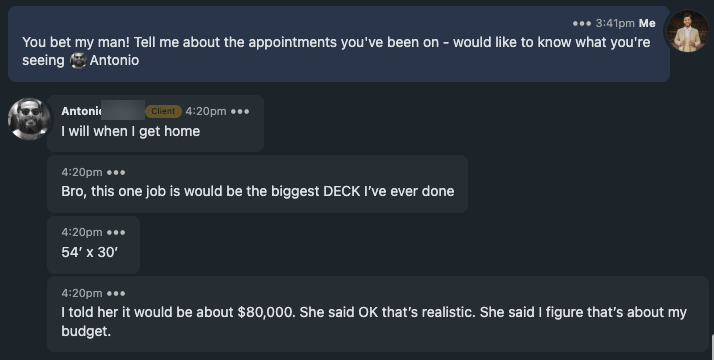
Across the 100+ contractor businesses I've worked with, a few patterns show up again and again.
- The phone is the ranking factor nobody tracks. Owners spend months climbing the map, then send the calls to a voicemail box that's been full since spring.
- Old reviews stop working. The companies that win keep asking every month, not once when they remember.
- Real photos beat everything else on the profile. Homeowners want to see your crew and your work, not a stock photo of a man pointing at a blueprint.
- Small markets are the easiest maps to own. Fewer competitors and shorter distances mean a complete profile goes a long way.
- SEO pays off most when something else fills the calendar first. The owners who stick with it for a year aren't panicking about next month. More on that in SEO for contractors: does it actually work?

Common Questions
How long does local SEO take for a contractor?
Profile and review fixes can move map rankings within weeks. Website pages and links usually take 6 to 12 months to compound. Judge it on calls and signed jobs from search, not on a ranking report.
Can a contractor rank in towns where they don't have an office?
In the map results, it's hard, because Google weighs how far your business is from the person searching. In the regular search results below the map, yes: a strong service page with real jobs from that area can rank well beyond your address.
What matters more for local SEO, reviews or the website?
Reviews decide whether you get picked, and the website decides whether you rank outside the map. BrightLocal's 2026 survey found 47% of consumers won't use a business with fewer than 20 reviews.
Should I put keywords in my Google Business Profile name?
No. Google's guidelines say your profile name should reflect your business's real-world name, as used on your signage, website and paperwork. Put your services and service area in the fields built for them.
Do I need a separate page for every city I serve?
Only for cities where you have real local material: jobs you've done there, local photos, local reviews. A page that only swaps the city name is the kind Google tends not to index.
Where to Start
Start with the profile and the reviews this week, because they're cheap and they move fastest. Then build the service pages that let you rank beyond the map. If you'd rather hand it off, our contractor SEO service builds all of it, standalone or alongside the appointment system.
And Bob, if you're reading this, change the name back. "Cheap Affordable" was never the brand you wanted on a $40,000 deck anyway.