Most construction companies already have a marketing plan. It's a truck with a logo on it, a cousin who knows a guy, and a website a nephew built in 2019 that still opens with the word Welcome.
That worked for years, because the next job came out of the last one. Then the flow thinned. Census figures that NAHB wrote up on November 2 put private residential construction spending at an annual rate of $848.8 billion, down 8.9% on the year, with home improvement work down 18% against a year earlier.
That isn't a slow month. It's a smaller room with the same number of contractors in it. So now you're doing construction marketing, which mostly means being sold things by people with a slide about funnels.
Below: what your buyer actually does with their year, which strategies pay, and how to tell inside a month whether any of it worked.
On this page:
- What construction marketing is
- Why it's a different problem
- The strategies that pay
- Where homeowners find you
- Marketing through a slow stretch
- What a booked appointment costs
- What we see in the field
- Common questions
What Is Construction Marketing?
Construction marketing is everything that gets a homeowner who is planning a project to call you instead of the other two companies on their list. For a general contractor or a residential builder, it's four jobs in a row.
- Get found by a homeowner who hasn't picked anybody yet.
- Get trusted well enough to be invited into the house.
- Get a booked estimate onto a real calendar with a real date on it.
- Stay in the conversation through the months before anyone signs a thing.
Three of those four are the ones nobody sells you. Getting found has a shopping cart attached to it, so it's the part the whole industry wants to talk about. You can buy traffic by Thursday, then refresh the dashboard nine times before lunch, which is also how I treat a parcel tracking page. Trust, a booked calendar and a follow-up that survives until March don't come with a dashboard, and they're where the money is.
There's also a difference between marketing and buying leads, worth saying out loud because the invoices look identical. Marketing builds something you keep: a name homeowners recognize, reviews, a list, a page that ranks. Buying leads rents you a stranger's attention for ninety seconds, usually next to eight other companies who rented the same stranger. The full channel-by-channel list lives in digital marketing for contractors.
Chris W., a custom deck and home builder in Gulf Shores, Alabama, on his first two months: $320,000 of jobs booked and 13 to 14 appointments every week.
Why Marketing for Construction Companies Is Its Own Problem
Marketing for construction companies has to survive a decision that takes most of a year. The 2026 Houzz & Home Study, which surveyed more than 20,000 US homeowners between January and March, clocked the average kitchen at 9.5 months of planning and 5.8 months of construction. The planning takes longer than the build.
That order changes where the money goes. The homeowner who signs with you in September started thinking in January, and for most of those months they weren't searching for anything at all. They were measuring a wall, arguing about an island, and sending each other photos at eleven at night.
Nine and a half months is long enough to produce an entire baby. The baby usually arrives before the kitchen does, and the baby requires fewer change orders.
You've been this homeowner. You decide in February that this is the year, you save nine photos of the same backsplash, and you tell exactly one friend it's happening. Then somebody gives you a number that makes you quietly close the tab, and by June the whole thing has been reclassified as something you'll do when the kids are older.
| The stretch | What the homeowner is doing | What most construction marketing is doing |
|---|---|---|
| Early | Saving photos, no company in mind yet | Nothing: nobody has searched for anything |
| Middle | Asking around, reading reviews, sizing up money | Nothing: no form has been filled in |
| Quote time | Getting two or three companies out to price it | Arrives here, against everybody else at once |
| After | Signing, then living inside a building site | Asks for a review, eventually |
That same study found 91% of renovating homeowners hired a professional, and general contractors were the pros they hired most, engaged by 29% of them. Demand for your job title isn't the problem. Being the company they can name in month four is the problem.
In that study 75% of renovating homeowners set a budget and 37% went straight through it, most often because products and services cost more than they had planned for. Your buyer's biggest fear isn't your price. It's your price moving after they've said yes.
Every homeowner also has a friend whose bathroom somehow cost double, and that friend attends every estimate you will ever give. You won't see them. They're sitting right there, asking about the allowances.
Marketing Strategies for Construction Companies, Ranked by What They Pay
Only two things make a construction company's marketing pay. It reaches the homeowner before the quote stage, or it makes your estimate the easiest one to say yes to. The marketing strategies for construction companies below are in the order I'd build them, and anything that passes neither test is branding with extra steps.
Everything on this list is dull on purpose. The fun version of marketing is a new logo, a truck wrap and a box of koozies with your name on them, and a koozie has never booked an estimate in its life. It sits in a cooler, being loyal.
Give the planning homeowner something to raise a hand for. Nobody fills in a form that says Contact Us eight months out, because there's nothing in it for them. A design, a walkthrough, a straight number on what a project like theirs costs in your town: those get a hand up in month three. You're not trying to close anyone that early, you're trying to be the company they've already met.
Put the owner on camera in the ugly part of the job. The best construction ads I see are an owner holding a phone in a half-demolished kitchen, explaining the thing behind them. Homeowners can't grade your framing, but they can tell inside four seconds whether you've stood in a hundred of these. One two-hour shoot in the parts of a jobsite nobody photographs is weeks of ads.
Filming yourself is grim for about a week and then it isn't. Every owner hates the first take, watches it back anyway, and hears a voice they're fairly sure isn't theirs.

Answer like a company that wants the job. A planning homeowner who finally raises a hand has done something effortful, and they're fragile about it for roughly an afternoon. Reaching them in minutes instead of days is the cheapest improvement available to you, and it needs a system that doesn't depend on you being free. Every hour you wait their enthusiasm gets a little more sensible, and a sensible homeowner starts a spreadsheet.
Nobody raises a hand at a convenient moment either. It's always while you're on a roof, under a sink, or holding one end of something heavy, which is exactly why the answering can't be your job.
Make the estimate the product. If your buyer's real fear is the number moving after they sign, then the company that explains its number in writing, with what's included and what would change it, beats a cheaper quote scribbled on a napkin.
A number with its working shown survives the friend with the doubled bathroom. A napkin does not. Write it like somebody's spouse is going to read it out loud in the car, in the voice people save for things they've already decided to be suspicious about.
Put the allowances where a human can find them, too. Most estimates I read bury the one number most likely to move right at the bottom, under the paragraph about the dumpster.
Farm the street you're already standing on. A new deck going up is the best advertising that street will ever see, and a card in forty mailboxes is cheap. And every homeowner who asked for a price and went quiet isn't gone. They're in month five.
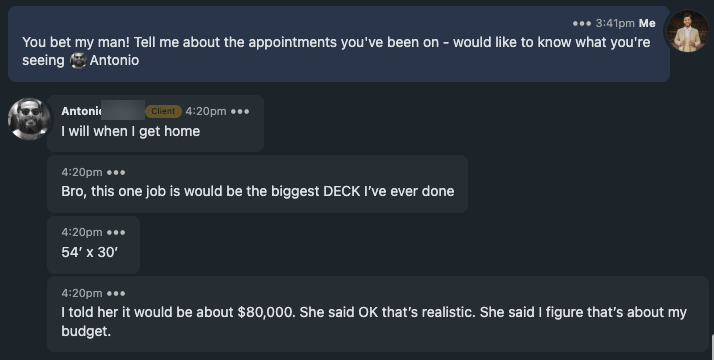
Own the pipeline instead of renting it. A shared lead is paying to be one of nine voicemails on a stranger's phone, and the stranger decided to be annoyed by all nine somewhere around the fourth. Chip P., a deck builder and general contractor in Loomis, California, was reaching about 2 of every 10 homeowners on the shared leads he bought.
On a page of his own, where the homeowner asks for him by name and nobody else is handed the number, he was talking with at least 8 of 10. That's the whole argument for owning the thing rather than renting it. If you'd rather not build it yourself, that's what our marketing for general contractors does.
Where Homeowners Find a Construction Company in 2026
Homeowners find a construction company through a neighbor, a search, a map and now an AI answer, and they check every one of those against your reviews before they call. The 2026 BrightLocal consumer review survey has 97% of consumers reading reviews of local businesses, and 41% reading them every single time they look at one.
The part that should worry a construction company is the shelf life. In that survey 74% only count reviews written in the last three months. Your five-star wall from 2023 reads like a shop with the lights off. And 18% of them won't count a review older than last week, which is an unreasonable standard they will absolutely be applying to you.
Another 31% now say they'll only use a business rated 4.5 or better, up from 17% a year earlier. That isn't a reputation problem, it's a math problem. Two old sour reviews and a thin recent record quietly delete you from a shortlist you never knew you were on. There's a homeowner in your town scrolling past you on a 4.3 right now, feeling like they dodged something.
Then there's the new one. AI tools like ChatGPT have gone from 6% to 45% as a place people get local recommendations, the third most popular source in that survey, and Google's share of review reading dropped from 83% to 71% in the same year. A homeowner is now asking a chatbot which builder to use, and the chatbot answers with the confidence of a brother-in-law.
Nobody gets to see inside that answer, which is the part that gnaws. You can't call ChatGPT and ask why it likes the other guy, so you'll settle for asking the same question four different ways to see if it changes its mind. It won't. It just gets more polite about it.
What it means in practice is dull and important. The things an AI answer gets built from are the things you'd want anyway: a site that says plainly what you build and where, reviews with recent dates on them, and your name turning up on pages you don't own. The mechanics are in local SEO for contractors, and what to ask before you hand any of it over is in choosing a contractor marketing agency.
Marketing a Construction Company Through a Slow Stretch
A slow stretch is the cheapest time to market a construction company, because it's the stretch when your competition stops. Attention gets cheaper in the exact months everybody decides to save money, and the homeowners planning spring work are planning it right now.

Everyone believes the opposite, which is the whole opportunity. The standard move when the phone goes quiet is to cut marketing first, because it's the only line item that never phones you back. Then the work dries up eight weeks later and the marketing gets blamed for not working, which it wasn't, because it was off.
Josiah W., a deck builder in the Flathead Valley in Montana, works a market of about 90,000 people. He was getting 40 to 50 leads a month out of it, and a 226-foot deck worth over $200,000.
A small market has fewer homeowners in it and far fewer companies advertising to them, and the second half of that sentence is the half nobody says out loud. Everybody runs the first half of that math and stops, which leaves a town with one stoplight and exactly one contractor advertising in it. That contractor should be you.
I spent 12 months in this business without running a single ad for myself: a phone, a list of contractors, and free trials. It worked at roughly the speed you'd expect from one man dialing strangers in alphabetical order, and I'd love to tell you that was strategy. It wasn't. I just didn't have a better idea yet.
What a Booked Appointment Costs a Construction Company
Divide what you spent by the appointments it produced and you have what a booked appointment costs your construction company. That one number tells you more than any report anybody has ever emailed you. Nobody publishes a figure for construction worth trusting, so build your own out of the first month.
Here are three real ones. Take the shape and leave the rates, because your town and your average project decide the rest.
| Whose account | What went in | What came out | Per conversation |
|---|---|---|---|
| Derek L., outdoor living, outside Nashville | $1,295 over 30 days | 37 appointments, $46,000 signed | $35 an appointment |
| Mike H., deck builder, Minnesota | $27,000 with an SEO agency, before us | 10 appointments | $2,700 an appointment |
| David L., roofing, North Carolina | $12,000 of ad spend, January to March | 17 deals, $65,000 profit | $706 a signed job |
The first two rows wanted the same thing from the same kind of market. The cost of one conversation wasn't in the same universe, and the difference wasn't the budget. It was whether anything at the end of the spending had a calendar attached to it.
$27,000 handed over. Ten appointments back. Ten. I've seen trade show booths do better, and a trade show booth is where hope goes to collect a free pen.
Then take your own cost per appointment, divide it by the share of estimates you actually close, and you have cost per signed job. Put your average project value beside that. If those two numbers sit close together you don't have a marketing problem, you have a pricing problem.
Every owner I've walked down that sum does the same two things. Nods at cost per appointment. Goes quiet at cost per signed job and suddenly needs to check something in the truck.
I divided two numbers wrong on a client check-in once, live, with the client watching. The best I managed out loud was that I was tripping math, which is not a sentence, and then I told him it was funny, which it was not. So do it slowly, on paper, with your own numbers rather than mine.
The full version of that single number is in cost per appointment for contractors, and the channel-by-channel comparison is in contractor advertising.
What We See in the Field
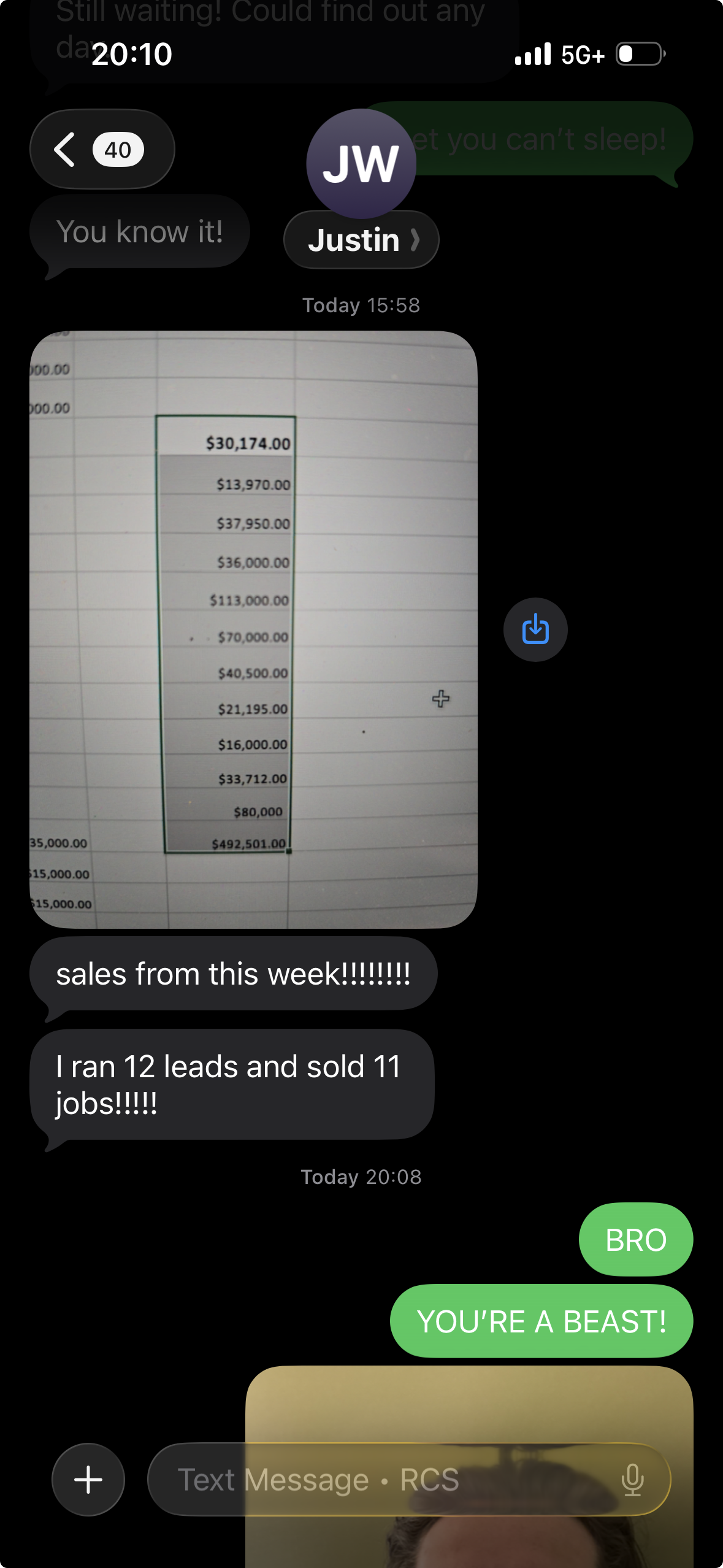
Across the general contractors and residential builders I've worked with, three things decide whether construction marketing turns into signed work.
- The calendar beats the creative. A plain ad asking for a date books more estimates than a beautiful one asking for a phone call. Homeowners won't call you. They'll book a Thursday at four and be visibly relieved nobody made them talk.
- The follow-up beats the ad. Most of the signed work arrives weeks later, from homeowners who were never going to book on day one, which is exactly what a nine-month planning window predicts. Week two is when an owner decides the whole thing is broken, usually on a Wednesday, usually in a truck.
- Capacity sets the ceiling. Chris W. got booked out 10 weeks and paused his ads to go hiring, which is the good version of this problem. Nobody plans for it. Every plan quietly assumes the phone stays exactly as busy as it is today, forever, and the week it gets busier is the week you find out you own one truck and a cousin.
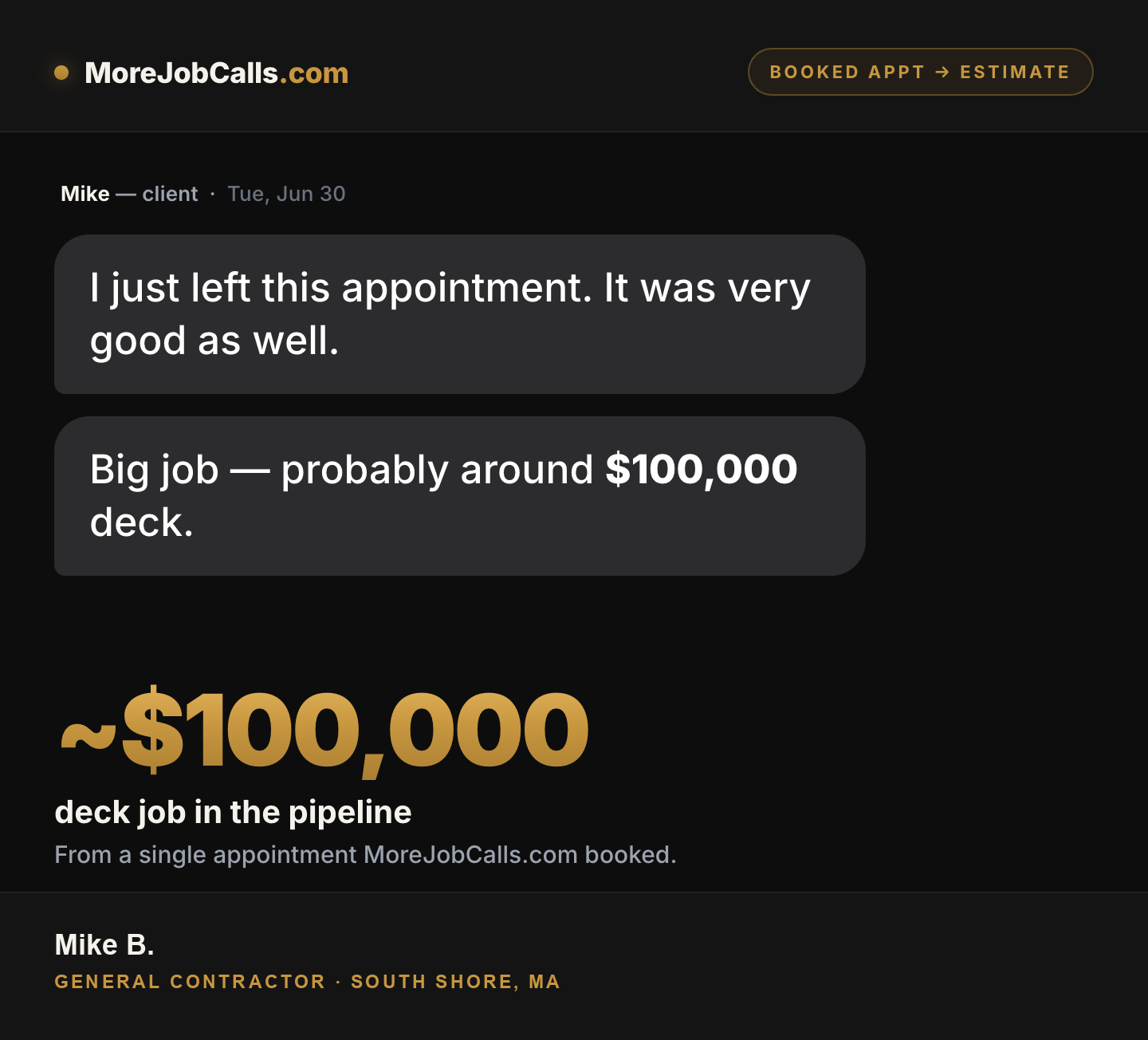
Mike B. is the clearest general contractor version of the whole argument. He builds decks and modular homes on the South Shore in Massachusetts, and he went from 3 appointments a week to somewhere between 3 and 11 a day, booked out close to 6 months.
Three to eleven appointments a day is still a problem. It's just the one you'd pick off a menu.
And then the quiet one. Ed M., a general contractor in Carlsbad, California, left this on Clutch: we're impressed with the personalized service from Spencer. Nobody screenshots that sentence, and it's the one that makes a construction company stay.
Common Questions
What is construction marketing?
Construction marketing is how a general contractor or builder gets found by homeowners planning a project, earns enough trust to be invited in to quote, and stays in touch through the months before anyone signs. It covers your website and reviews, search and paid ads, video, referrals and follow-up.
How do construction companies get customers?
Mostly from past customers, from search, maps and reviews, and now from AI answers. BrightLocal's 2026 survey found 97% of consumers read reviews of local businesses, and 45% use AI tools for local recommendations, up from 6% a year earlier.
What are the best marketing strategies for construction companies?
Give a planning homeowner something worth raising a hand for, put the owner on camera showing real work, answer quickly when somebody asks, write an estimate clear enough to beat a cheaper one, and market to past customers.
How much should a construction company spend on marketing?
There's no published benchmark worth trusting, because it turns on your average project value and how many estimates you can run. Work out what one booked estimate costs you and what one signed job is worth, and the budget question answers itself on a strategy call.
Does marketing work for a small construction company?
Yes, and often better, because fewer companies are advertising there. Josiah W., a deck builder in Montana, was getting 40 to 50 leads a month in a market of about 90,000 people.
How long does construction marketing take to work?
Booked estimates can start inside the first week, because some homeowners are already late in their own planning. Signed jobs take longer, because the average kitchen gets 9.5 months of planning before anybody builds anything.
One last word about that truck with the logo on it. It's genuinely good marketing, it just only reaches the street it's parked on, and the homeowner in month four lives three towns over with a kitchen drawer full of printouts. They're never walking past your truck. Park it, and go and find them.
Where to Start
Start with the page your buyer is already hunting for: the honest one for the project you want more of, covering what it costs in your town, what's included, and what would change the number. Almost nobody in your market has written it. The homeowner in month four is looking for it tonight, on a phone, in bed, next to somebody who has opinions about islands.
If you'd rather not build the rest of it yourself, book a strategy call. We'll run marketing for general contractors and residential builders inside your own ad accounts, and by week one you'll know what a booked estimate actually costs you.